
AIR CAR HALL OF FAME
Roy Jerome Meyers
Roy Meyers was the most famous air car inventor of the 1930s.
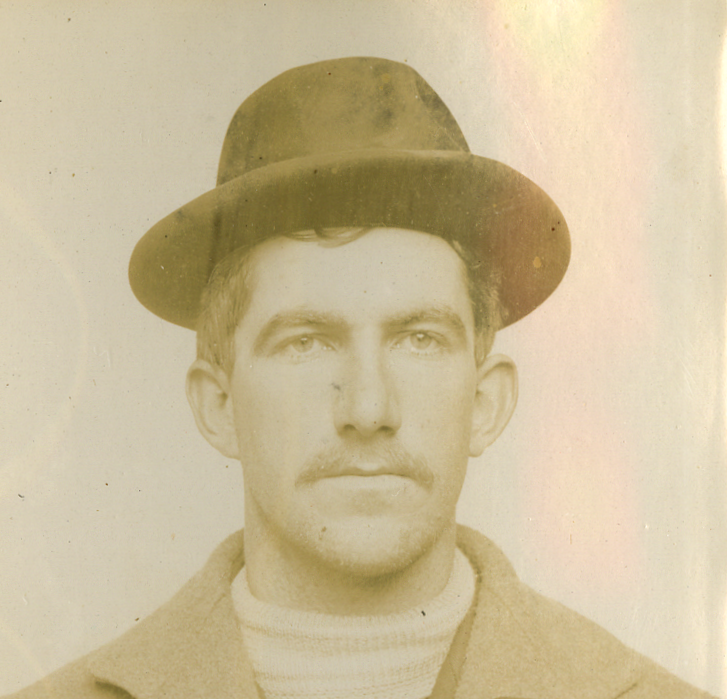
Roy J. Meyers in 1900
- Invention Summary
- What the Inventor Claimed
- What the Publicity Stated
- Inventor Biographical
- Patents
- Work Experience
- Family Background
- Personality
- Legal Problems?
- Articles & Graphics
Invention Summary
What the Inventor Claimed
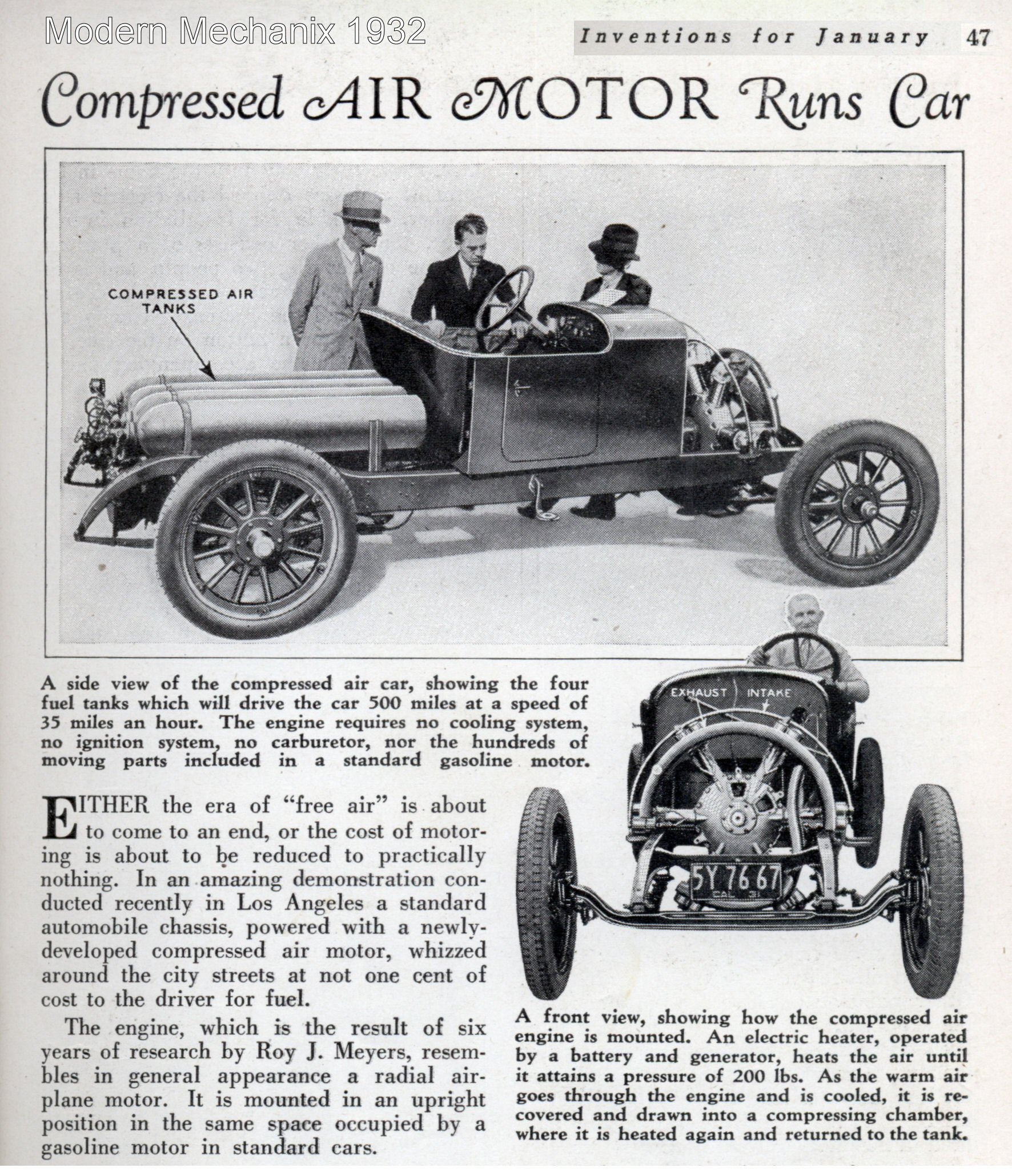
The air car was able to travel from Los Angeles to Bakersfield, about 110 miles.
What the Publicity Stated
The car was demonstrated in California and featured in many newspaper and magazine articles. It was featured in a News Reel which we haven't found.
Inventor Biographical
Patents
Meyers/Hiebert air car patents: Compressor US 1654893 in 1928; Fluid Pressure Generator US 1608801 1926 (also Germany 512184 1930, Canada 272752 1927, Great Britain 266712 1928)
other patents: Apparatus for Producing Electricity Great Britain no. 1098 granted 1914; Vehicle Brake US 1550833 1925; US 1477710 1923 Operating Combustion Engines from Calcium Carbine Gas; US 2835491 1958 Merry Go Round
Work Experience
school janitor age 11, self-taught electrician and machinist, mechanic, inventor, machine shop foreman
Family Background
The Roy J. Meyers story would make a good Hollywood movie, or at least a good Netflix biopic.
Roy J. Smith was the son of Charles Morton Smith and Alzoa Amy Minkler. In 1900 he was using the name C. M. Meyers but by 1912 he'd settled on Roy Jerome Meyers which he used the rest of his life. He was born in Edgewood, Iowa.
Roy's father died when he was 11 and he quit school to work as the school janitor in order to support his mother and sister. A few years later his sister died. Roy hit the road and made some bad mistakes when he got hungry. He was socially inept and didn't choose good company. But he married a good woman, Carrie Weller, and she stuck with him through thick and thin. Her parents were Francis F. Weller and Aubin Markham Hutchins. Roy's father-in-law grew up next door to the Vicks family of Vicksburg, Mississippi. Carrie's grandfather was the well-known Episcopal priest Rev. George Weller.
Roy worked hard all his life. Among his misadventures as a young man was his attempt to use his savings to buy a restaurant in Stockton, California. He lost everything in this venture and believed he had been defrauded. Once he began showing his air car in the 1930s, he was done with trouble, but as a young man he was arrested twice for bad checks and accused twice of bilking investors by means of exaggerating what his invention would do. This is a common ploy of investors who bet on an inventor and lost, when there was not necessarily any fraud involved. The investors have more clout with the courts than the penniless inventor, and they just want their money back. Another ploy is to complain to the Securities enforcers and have the inventor accused of selling shares improperly. Many inventors are stopped by their investors, and give up at this point, or are ordered to never try to market the invention again, whether it works or not.
After his second stint in prison for a bad check, Roy was living in New Orleans when he was accused of lying to investors about the abilities of his electrical absorber, and then accused of starting a fire to collect on the insurance. It's not known what came of this.
In spite of his troubles, Roy's famous air car of the 1930s seems to have a spotless reputation. The rest of his life as well seems untroubled as far as I know. It would be interesting to learn what became of that air car; maybe he sold it and bought a nice house for his wife and daughter. We don't know.
In 1900 Roy was traveling with an associate who he would regret being associated with. The way Roy tells it, the friend asked him to cash a check for him and didn't tell him the check was stolen. Roy was convicted and sent to Folsom prison in California at the age of 21. His mother went to a lot of trouble to collect character references from former employers who agreed that Roy was essentially a good man but naive, a poor judge of character when making friends, and easily influenced by shady characters. In 1911 when he was again sent to prison for a forged check, he told a similar story of being caught up with sly companions who took advantage of his gullibility.
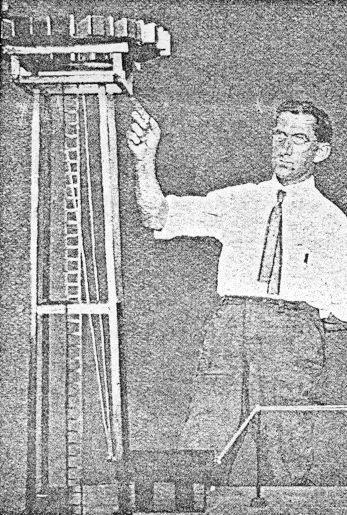
Roy became well known in 1912 as the "convict inventor", and again in 1931-32 as the most highly publicized compressed air car inventor of the 1930s. In 1912 he was befriended by the first governor of the new state of Arizona who got him a job in a nearby town as an electrical engineer in a mine, and let him live outside the prison walls. While confined in the Florence, Arizona prison, Roy had been given the job of caring for the pump and pumphouse. With access to a shop and tools, he secretly built the machine that obsessed his mind, and revealed the working machine to his captors when they questioned his activities.
A woman named Kate Barnard who was well known for advocating prison reform took up his cause when she learned of his invention, a device which could absorb static electricity from the atmosphere. The governor of Arizona was also interested in prison reform, and corresponded with Roy when he was in prison. Due to the speech given by Miss Barnard, the state legislators paid out of their own pockets for Roy to take his first electrical absorber to the patent office in Washington DC. He traveled there unsupervised and returned to prison on his own when the procedure was finished. The US patent was never granted as far as we know, but it was granted in Great Britain.
A man named W. E. Chenot became a champion and part-time financier of Roy's invention, writing articles in favor of the work, as well as a sympathetic biography, but eventually something about the relationship soured and Roy later accused Chenot of being out to steal his work. This sort of thing is par for the course, and the truth will never be known. While Roy's idea was considered perpetual motion or magic in 1912, absorbing static electricity from the atmosphere is considered a matter of harvesting available ambient energy today, although it's not being done on a large scale.
In the 1920s, Roy's first air car project was undertaken with a police officer named Fritz Hiebert as his partner. Roy lived in the Los Angeles area during all his air car activity, as far as we know. However he could have been known to air car inventor George Heaton, since they both lived in Sacramento, California in the 1950s. Meyers and Hiebert were accused by investors of making false promises due to the fact that Roy was still naively using the term "perpetual motion". He and Hiebert were arrested and it's not known what became of the charges. In the 1930s Roy obtained two patents on his new air car invention in the US as well as patents in Great Britain, Canada, and Germany. This was his third air car and he demonstrated it from coast to coast. He never called it a perpetual motion device, and engineers who saw it working vouched for its authenticity. Many photos of the car and inventor were published in newspapers all over the country as well as magazines such as Popular Mechanix.
Roy was a professional machinist, and a self-taught electrician and mechanic. He also worked as a chauffeur. During his life he lived in Northern California, Southern California, New Orleans, Nebraska, and Arizona. He also lived briefly in other places including Alaska, Baltimore, Chicago, and New York City.
Dorothy S. Weitz was the only child of Roy and Carrie Meyers. Dorothy is buried in Roswell, New Mexico.
Roy obtained a number of patents on industrial and automotive devices. His last patent was granted a few weeks after his death. It was for a merry-go-round powered by a teeter-totter, marketed as "The Meyersgoround". When I was traveling with my family as a child, we encountered a Meyersgoround and played on it.
Personality
Impressionable and naive in youth, causing him at least three minor run-ins with the law. No hint of violent behavior. Married to the same woman his whole life.
Legal Problems?
Imprisoned twice for bad checks. Accused of starting a fire to collect insurance. Accused of bilking investors when his inventions didn't measure up to his expectations. Regarding the air car that he became so well-known for, as well as the rest of his life, there are no known legal problems.
Articles & Graphics
More information on the inventor and the invention, if available:
- Modern Mechanix article, January 1932, Meyers air car
- Roy Meyers highlights, summary written in 2011
- News Reel, 1930s, please send a copy if you find it.
- Roy Meyers with his 1912 electrical absorber invention
- Roy Meyers' life story in his own words, age 21
- Roy Meyers bio written by W. E. Chenot from Arizona archives
- Roy Meyers' 1900 prison record
- Roy Meyers' 1911 prison record
- Roy Meyers and Governor Hunt Arizona archives (189 pages)