AIR CAR HALL OF FAME
Homer Calvin Busby
Homer Busby was a busy man. Newspaper accounts of his various businesses, lawsuits, etc. are too numerous to mention.
- Invention Summary
- What the Inventor Claimed
- What the Publicity Stated
- Inventor Biographical
- Patents
- Work Experience
- Family Background
- Personality
- Legal Problems?
- Articles & Graphics
Invention Summary
What the Inventor Claimed
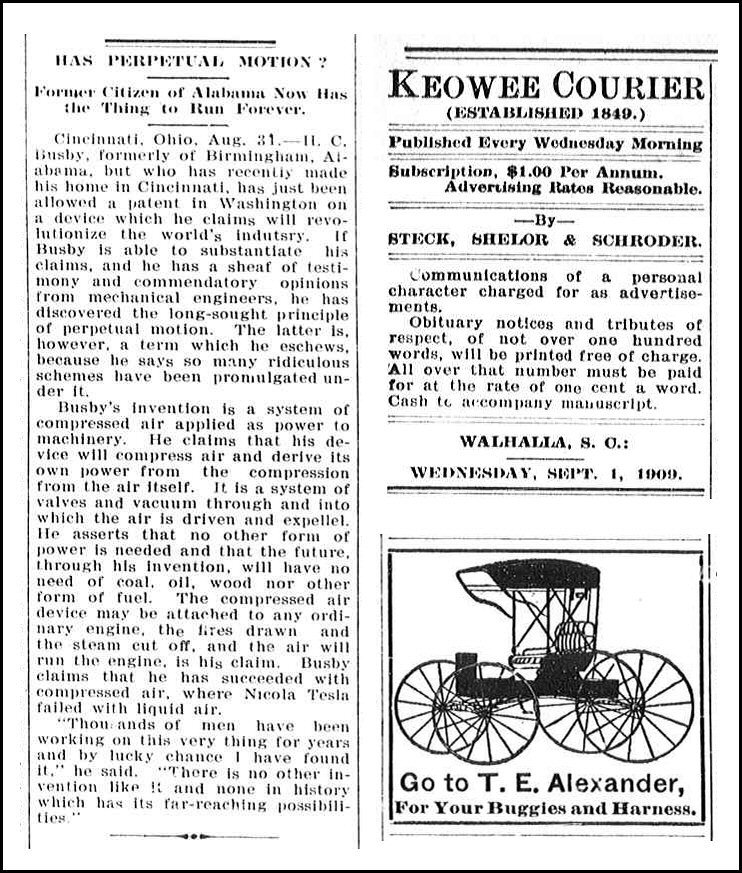
"...device will compress air, and derive its own power from the compression from the air itself. It is a system of valves and vacuums through and into which the air is driven and expelled... no other form of power is needed..."
What the Publicity Stated
Regarding the air compressing system(s), there were a few newspaper articles and advertisements, and in general he was often in the news for something.
Inventor Biographical
Patents
US Patent 943000, Dec. 14, 1909, "System of Utilization of Windmill Power" (networked windmills saving energy as compressed air;) fraud detecting/preventing ticket/receipt systems
Work Experience
8th grade education, railroad brakeman, insurance agent, President of National Compressed Air Co. (1910), collector (insurance), owner of private detective agency in New Orleans
Family Background
Homer Busby worked as a brakeman on the railroad as a young man, but by the turn of the century had settled for selling insurance and real estate. He and his wife Margaret McDevitt and their children lived all over Ohio; in Montgomery and Birmingham, Alabama; Jacksonville, Florida, and other places, before settling in New Orleans. Finally Homer started his own private detective agency in New Orleans.
Homer's dream was to be an inventor. He patented a system of windmills used to run air compressors which would supply a whole city with compressed air as a utility. His system for marking railroad tickets to protect against fraud was patented in the US, Canada, and the UK.
Homer's parents were Benjamin Busby and Virginia Harper. His mother's grandfather, Cornelius McDermott-Rowe, was an architect who worked for George Washington in the remodeling of Mt. Vernon. Homer had at least nine siblings, and he and his wife Margaret had six children.
The only known photo of Homer Busby was lost in Hurricane Katrina.
Personality
Homer was an active, restless person. He and his family moved around a lot, and one day on their way to Texas, he and his family set foot in New Orleans and never left. Homer did not hesitate to sue anyone who had wronged him.
Legal Problems?
It's likely that his interest in fraud detection started when he worked as an insurance agent. As a young man he was accused of being a mastermind of a group of railroad employees who were stealing from the baggage cargo. On his way to trial, he jumped off the train when it got to his future wife's town. They were married the next year. It's unknown what came of the "Panhandle Pilferers" accusation. Homer was still a brakeman for the railroad in 1896 when his train met with an accident and he was discharged. He sued to get his job back but lost the lawsuit and had to change careers.
Articles & Graphics
More information on the inventor and the invention, if available: