
AIR CAR HALL OF FAME
Lebbeus Conn Weltner
Six nested air tanks one inside the other, each one with a different sized compressor cylinder inside it, probably in order to conserve compression heat while compressing the air with a series of increasingly small pistons.
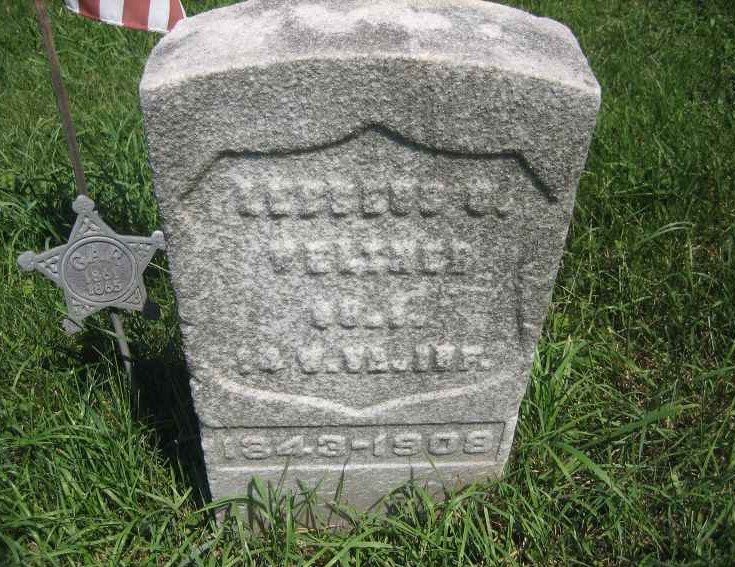
Lebbeus Weltner grave, photo courtesy of Albert B. Sloan
- Invention Summary
- What the Inventor Claimed
- What the Publicity Stated
- Inventor Biographical
- Patents
- Work Experience
- Family Background
- Personality
- Legal Problems?
- Articles & Graphics
Invention Summary
What the Inventor Claimed
"...mere existence will be a pleasure..." After manually filling the tank, it will keep itself full and make extra air for everything from cars to sewing machines.
What the Publicity Stated
A newspaper article after 26 years of work on the invention.
Inventor Biographical
Patents
None known.
Work Experience
farmer, Civil War veteran, inventor, pension attorney
Family Background
Lebbeus C. Weltner is the oldest inventor in this collection, even older than Lewis Kiser. He was born on 7 May 1843 on the same day that the first Japanese immigrant arrived in the U.S. He was 20 years old when his birthplace, West Virginia, became a state. By then trains were everywhere and everyone knew a brakeman. Everyone knew the power of compressed air because you couldn't stop a train without it.
While inventors start with an intended result and work backwards to try and find a way to achieve that result, engineers start with the laws of physics: "It can't be done!" and try to prove that an idea is against the laws of physics. To make matters easier, details are glossed over and generalities rule the day: "You can't get out more than you put in."
But that's not true of heat pumps, because the energy medium they make available was put there by the sun. This energy medium--ambient heat--is the energy that drives all air motors. Lebbeus knew this, and he knew that the means of compressing air had to be improved to take advantage of this fact. So he compressed air in little bites, and put each sub-process inside an air tank so the normally wasted heat would remain in the system and drive the compression process. Unfortunately, we don't know the details of exactly what he was doing.
As a small child in 1850, Lebbeus lived in what was then Monongalia County, Virginia with his grandparents John and Hannah and ten siblings, cousins, aunts, and uncles. Some of these folks might have been his parents, but in this house, parents weren't strictly needed. More relatives populated the farm down the street. He did not have a Facebook account. He started working in the fields when he was old enough to pick up a pebble.
By 1880, Lebbeus had married Frances L. Doty and they were raising their small family in Springhill Township, Fayette County, Pennsylvania. They lived next door to a relative of his mother's who was a local Justice of the Peace. Lebbeus was farming.
By 1887, Lebbeus had gained a reputation for being a "perpetual motion crank" which--in terms of compressed air--is often a code word for "solar energy enthusiast". Nikola Tesla didn't publish this distinction till 1900. Ten years before that, Lebbeus announced that his self-running compressor had been perfected, which usually means he was seeking financing to perfect it. He had spent his own money on the project for 26 years, ever since the Civil War ended, in which he'd served three years as a Private, promoted to Sergeant, for Company I of the 14th West Virginia Infantry, including six months as a prisoner of war at Andersonville. At Andersonville, even the prison guards didn't have enough to eat. By the time he publicized the invention, at the age of 47, he was suffering from rheumatism and asthma.
In 1900, Lebbeus and Frances were living in Uniontown, Pennsylvania. His occupation was listed as "Inventor" and zero months unemployed.
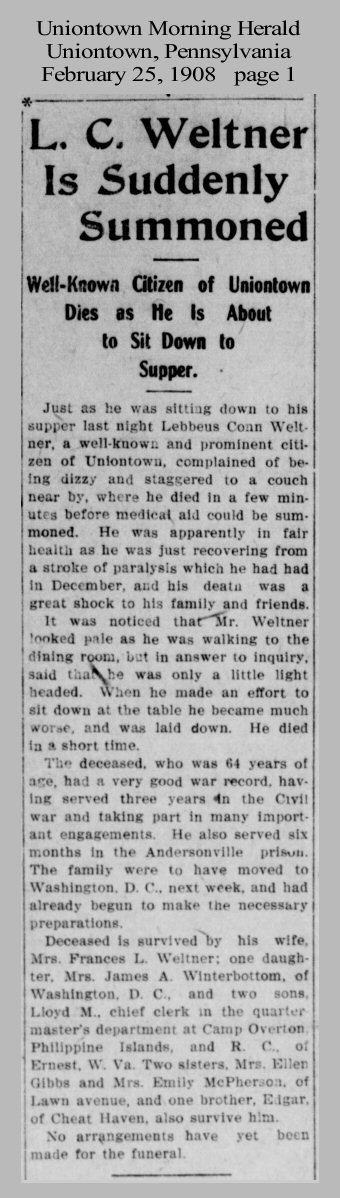
In 1908, the news article about his death called him a well-known and prominent citizen. He had been recovering from a stroke and was partially paralyzed. He had been working as a pension attorney.
Lebbeus died suddenly at home on 24 February 1908 in Uniontown, Pennsylvania.
Personality
Inventor.
Legal Problems?
None known.
Articles & Graphics
More information on the inventor and the invention, if available: