
AIR CAR HALL OF FAME
Francis Edward Kenney
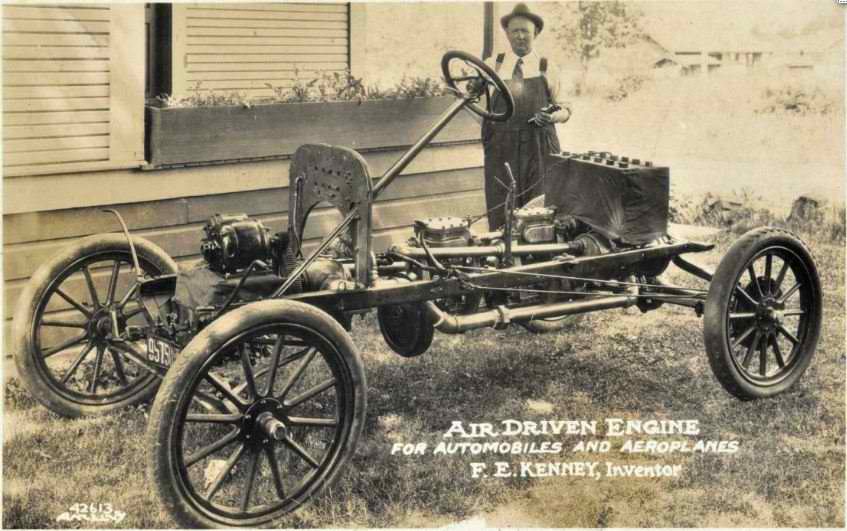
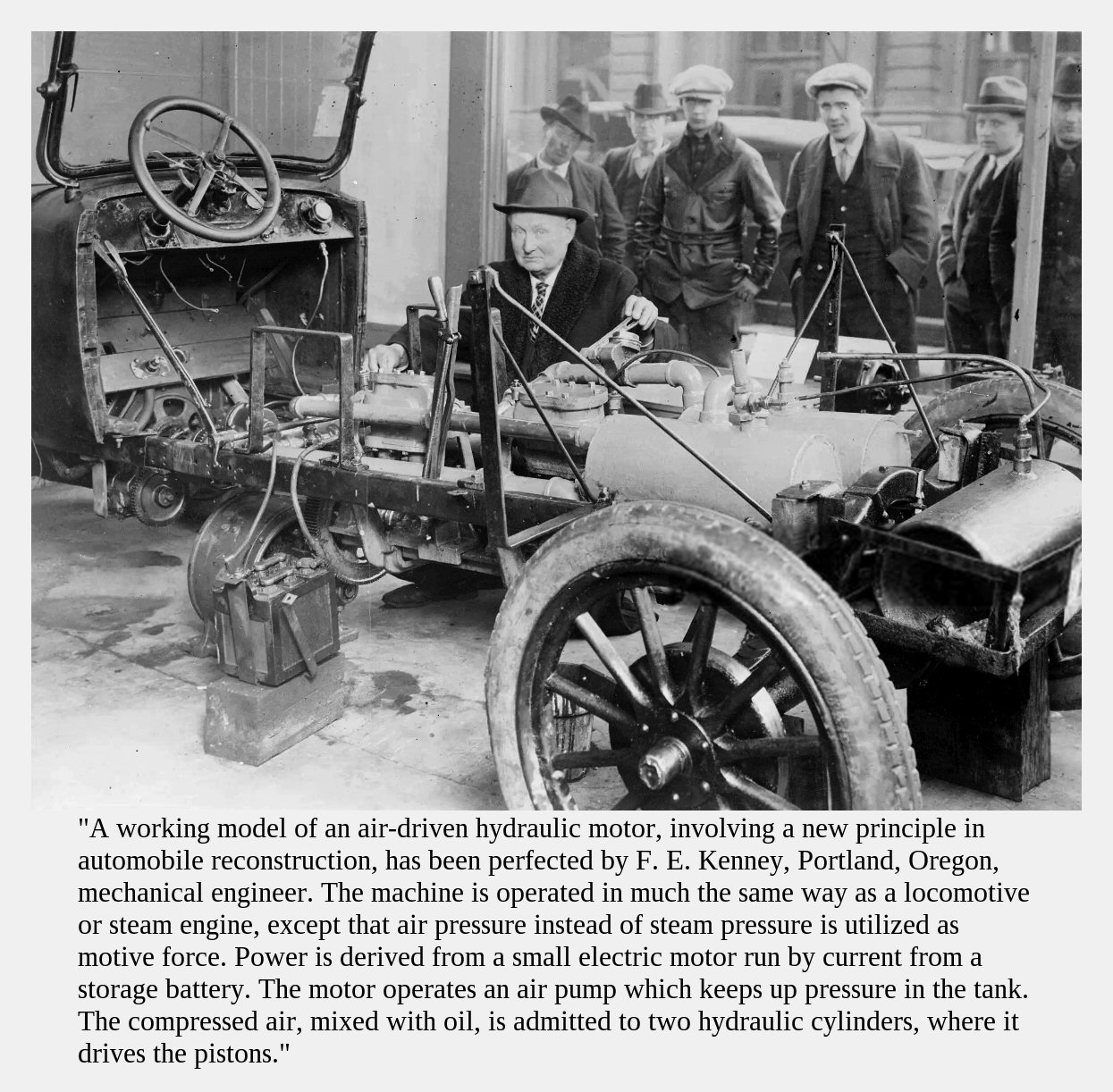
An electric or gas motor runs a compressor on a vehicle. The air is delivered to a vertical air receptacle partially filled with water. The water is caused to swirl violently. An injector powered by the hot air from the compressor circulates water from the main air receiver back to the vertical receptacle. This is probably a heat exchanger which tries to manipulate temperatures within the system advantageously to prevent the loss of compression heat from the system and make it usable to the car's air engine.
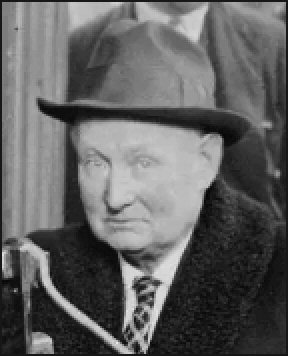
Frank E. Kenney
- Invention Summary
- What the Inventor Claimed
- What the Publicity Stated
- Inventor Biographical
- Patents
- Work Experience
- Family Background
- Personality
- Legal Problems?
- Articles & Graphics
Invention Summary
What the Inventor Claimed
Increasing the power available from compressed air, over what would be expected from typical compressors.
What the Publicity Stated
None known until a witch hunt by the Better Business Bureau accused the inventor of seeking investors without a license.
Inventor Biographical
Patents
1921 Canada Patent 211704A Hydro Pneumatic Power Machines (the air car; application 1914)
1912 US Patent 1046603A Injector Vacuum Producer (part of the air car)
1920 US Patent 1340547A Hydraulic Donkey Engine
1919 US Patent 1313545 Stump Puller
1916 US Patent 1195141 Hydraulic Log Splitter
1916 US Patent 1184699A Submarine Projectile
1913 Canada Patent 145135A Vacuum Producer
1911 US Patent 1002521 Vacuum Cleaner
1910 Canada Patent 123493A Faucet
1909 US Patent 915865A Polychrome Lantern
1908 Canada Patent 110951A Trolley Wheel
1907 Great Britain Patent 190622101A Trolley Wheel
1906 Great Britain Patent 22101A Trolley_Wheel
1901 US Patent 674339A Feed Water Heater
1901 US667149A Fire Apparatus
1896 US Patent 558183 Purifying Feed_Water
Work Experience
stationary engineer, manufacturer, inventor
Family Background
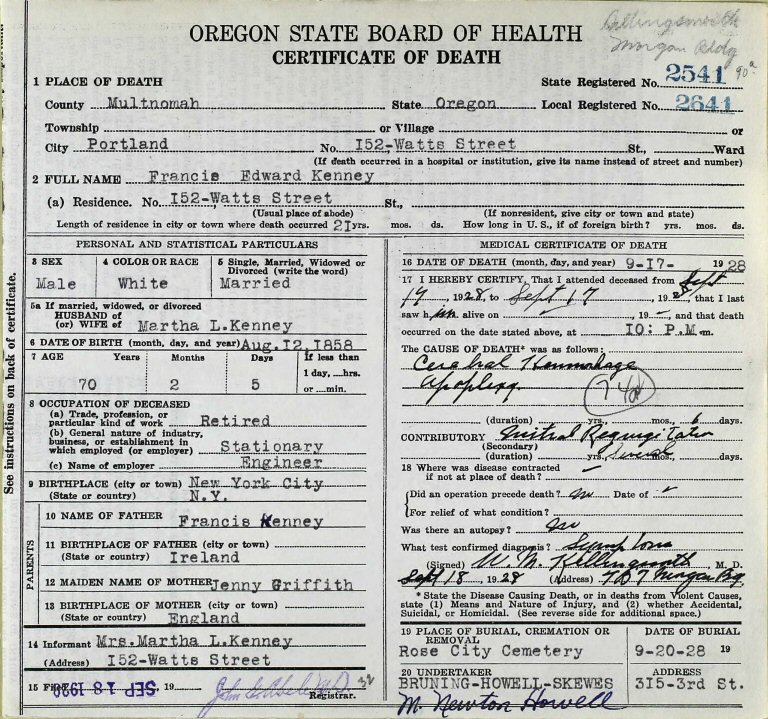
Frank Kenney was born in New York City on August 12, 1858 and died in Portland, Oregon on September 17, 1928. His parents were Francis Kenney, an Irish immigrant, and Jennie Griffith or Gruffydd, an English immigrant. Nothing else is known about his parents, and we don't know if he had any siblings, or what his life was like before 1885 when he suddenly appears in Saint Paul, Minnesota. Two years later he married Martha Lavina Bacon in Hastings, Minnesota, and they started their family in Saint Paul, Minnesota.
Frank and Martha had nine children: Marion Elizabeth Vogelgesang, Frank Leaton Kenney, John E. Kenney, Josephine Agnes Brownell, Harold Clifford Kenney, Ethel M. Kenney who died in Portland in 1907, Edythe Carmen Tilden who was born in Portland on October 4, 1907, Margaret May O'Reilly born November 22, 1909 in Tigard, Oregon, as well as another child who died before 1900. Frank Jr. died of influenza in 1911 after a world tour as a sailor in the US Navy and a year of working as a civilian in the shipyards. Mary Vogelgesang and her husband stayed in Saint Paul, where they owned a hardware store. Edythe Tilden was a businesswoman and avid sportswoman who also served as the city manager of Spenard, Alaska.
Martha Bacon was the oldest of the at least eight children of Edward and Agnes Bacon who started their life together in Orangeville, Ontario. Martha and several of her siblings were born in Canada. The family moved to Hastings, Minnesota where Frank Kenney married Martha in 1887.
In 1896, Frank publicized his water purifier invention. This machine was used by farmers for water used in threshers, and for the water used in steam engines. In 1898, Frank was discharged, for unknown reasons, from his position as assistant engineer at a pumping station for the Saint Paul water department. He wrote a long letter to the newspaper (which we couldn't find), explaining why he thought he'd been discharged for political reasons such as belonging to the wrong political party--the Republican party of those times. The water department's board of directors went out of their way to hire another Republican as his replacement.
In 1900, Frank publicized his smoke exhauster, which used flowing water from a fire hydrant and an ejector of his invention to remove smoke from burning buildings. He offered to sell his working model to the local fire board for $1000. A test was undertaken under the supervision of a famous local firefighter, in which a fire was built in the basement of a machine shop.
In early 1907, the Kenney family moved to Portland, Oregon where Frank worked as an engineer as usual. We have no record of his doing any kind of work other than inventing, manufacturing, and engineering, although we know nothing about him prior to 1885 except that he was born in New York City. In 1908 he bought a classified ad in the newspaper to try and find his missing cow. In 1913, he was the victim of a holdup. The criminal was arrested.
In 1915, Frank made a splash with the "F. E. Kenney Stump Puller", known in 1916 as the "Economy hydraulic stump puller and splitter", a one-man hydraulic stump and cordwood splitter that he sold in three sizes. This eliminated the need for dynamite in removing tree stumps. Also in 1915, Frank was one of the founders of the Viggers Iron Works corporation. By 1917 he was the president of the Kenney Economy Hydraulic Co.
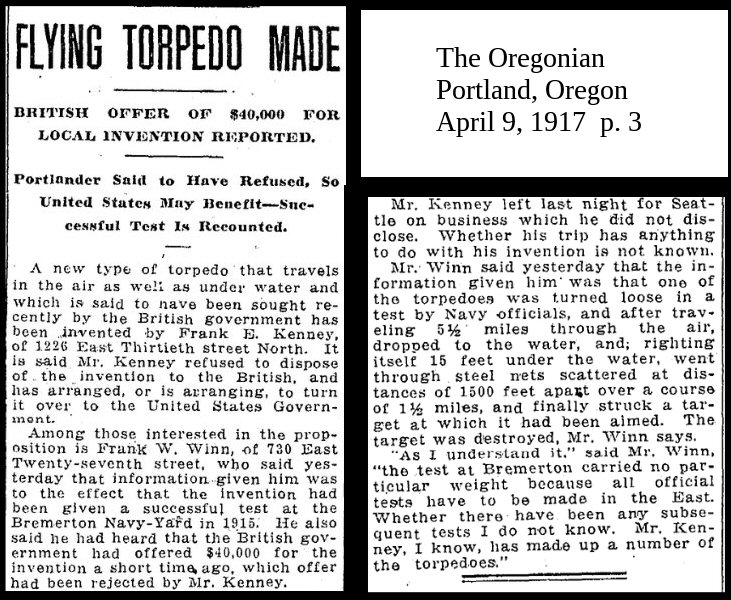
In the spring of 1917, Frank publicized his torpedo invention, which could travel through air or sea. The device had been tested successfully at a naval yard two years earlier. The British offered him $40,000 for it, but he turned them down, offering it instead to the US military.
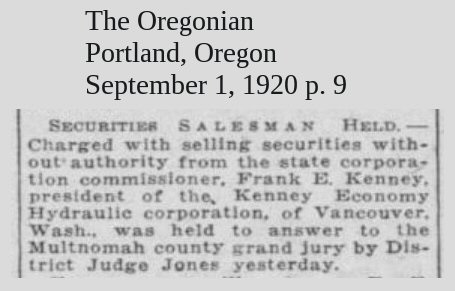
By 1920, the Portland city directory had been listing Frank as an inventor, rather than as an engineer, for a few years. That year, Frank was accused of selling stock in his log splitter corporation without a license. He asserted that it was his property to sell, and he didn't need permission.
In 1921, F. E. Kenney advertised in Salem, Oregon for "a good man with $300 to take up a first class, good paying business." He was staying in a local hotel.
In 1925, Frank was still listed as an inventor rather than an engineer in the city directory.
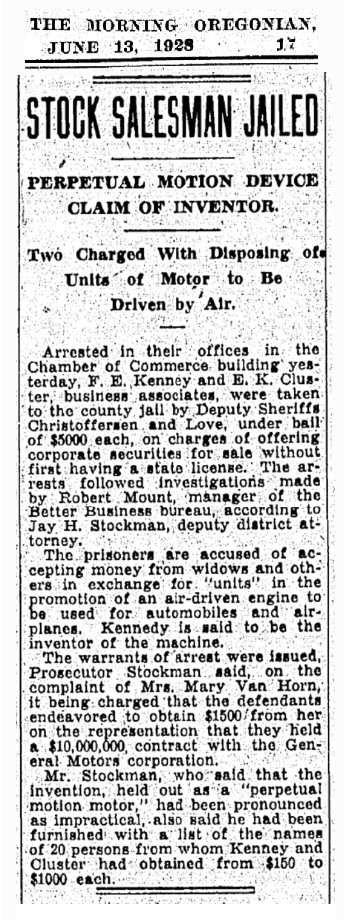
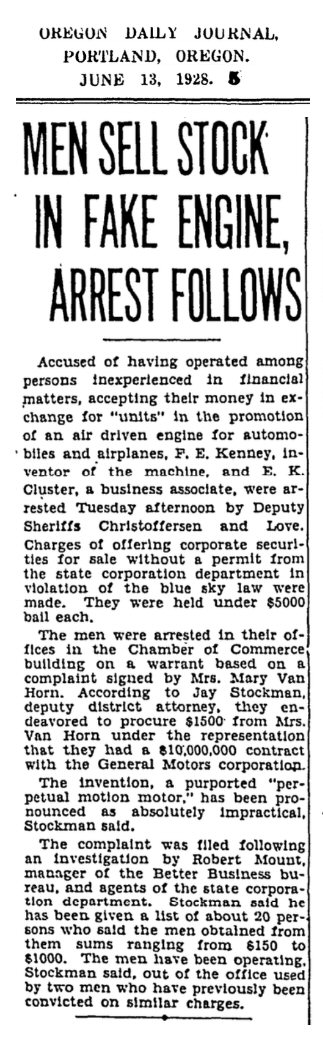
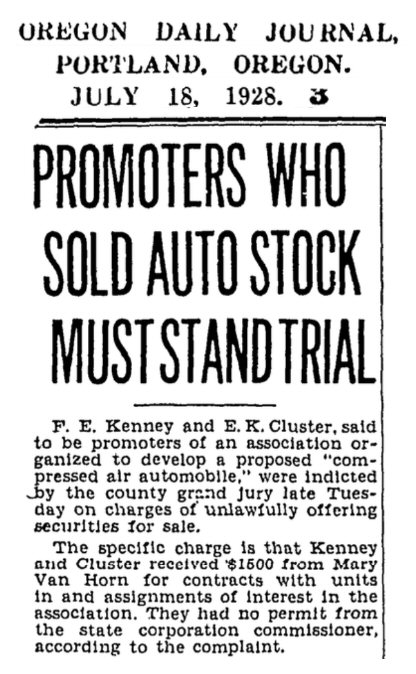
In June 1928, Frank and his business partner Eddy K. Cluster were arrested and accused of bilking little old ladies out of their life savings with a "fake engine" for a perpetual motion compressed air car (see photos and patent of the real air car(s)). As usual in cases like this, the newspaper acted as judge and jury in a sarcastic ranting barrage of ridicule and exaggerated hyperbole guaranteed to entertain.
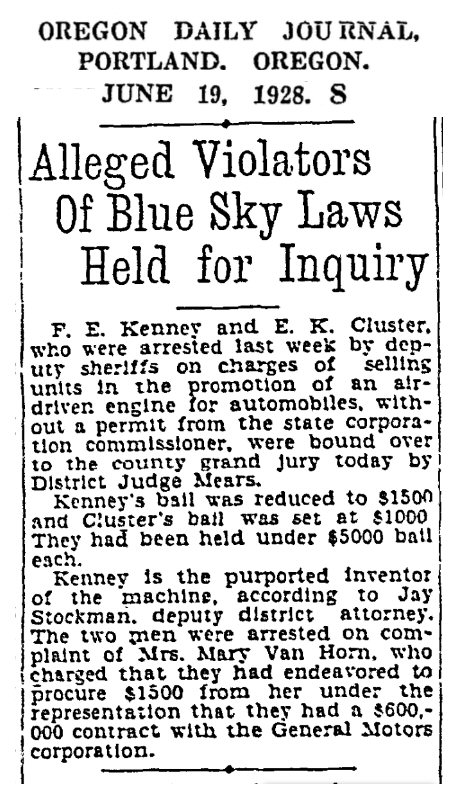
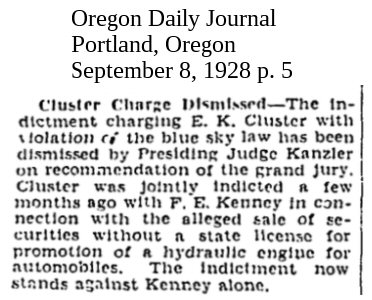
A little old lady had supposedly claimed that they bilked her out of $1500 by claiming that General Motors had given them a contract for ten million. As readers followed the case, the "ten million" supposedly promised by GM quietly crept down to $600,000. The reporter remembered to say "allegedly". The "corporation" of Kenney and Cluster turned out to be an "association". On September 8, after a series of progressively less exciting newspaper articles, it was quietly noted that Eddy Cluster's charges had been dismissed completely. Only Frank was still in the hot seat.
Nine days later, on September 17, 1928, Frank Kenney, listed on the death certificate by his wife as a retired stationary engineer, died of a debilitating stroke.
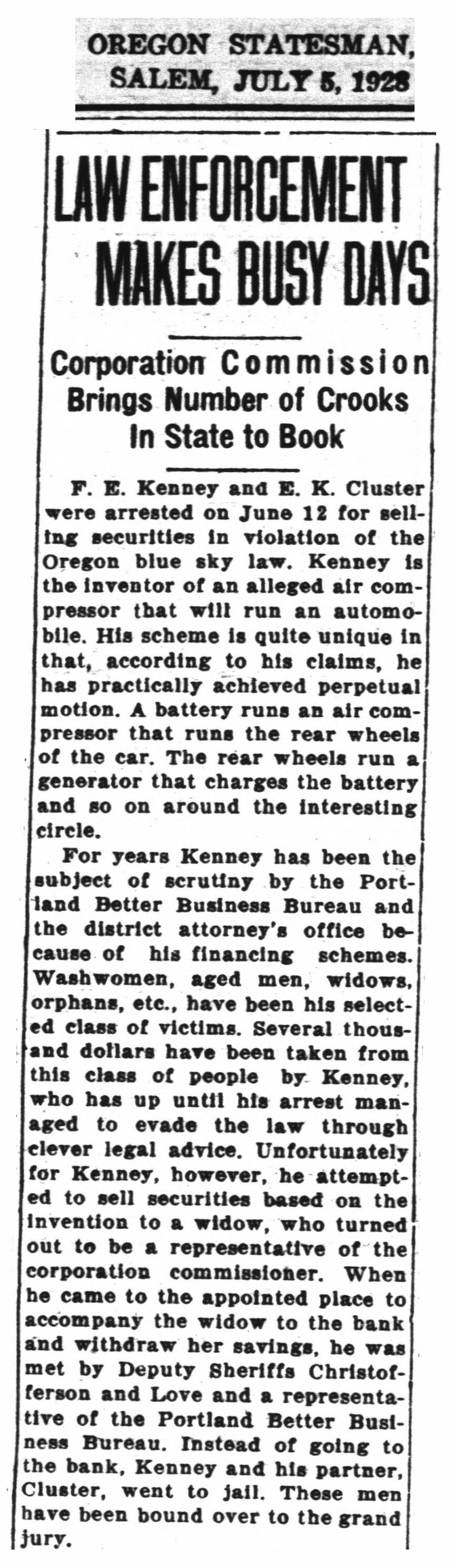
I believe that, if I'd have been in his place, after a lifetime of striving to support a large family and looking forward to retirement in order to concentrate on a passion to invent something great... I would have had a stroke too. The little old lady that had promised them $1500? She turned out to be not just any little old widow lady, but also a representative of the corporation commissioner, cooperating in entrapping the two men. Allegedly. It seems like the Better Business Bureau was on a witch hunt in those prohibition days.
As a professional engineer, manufacturer of real machinery, and experienced inventor with several patents, Frank Kenney would have had nothing to do with perpetual motion claims. These poison words came from overly zealous accusers and the sensation-mongering press, not from Kenney. His patent discusses fluid interactions, injectors, possibly advanced heat exchange devices. He was certainly smart enough to never mention perpetual motion. But what do I know? I wasn't there, and I don't want to make up stories.
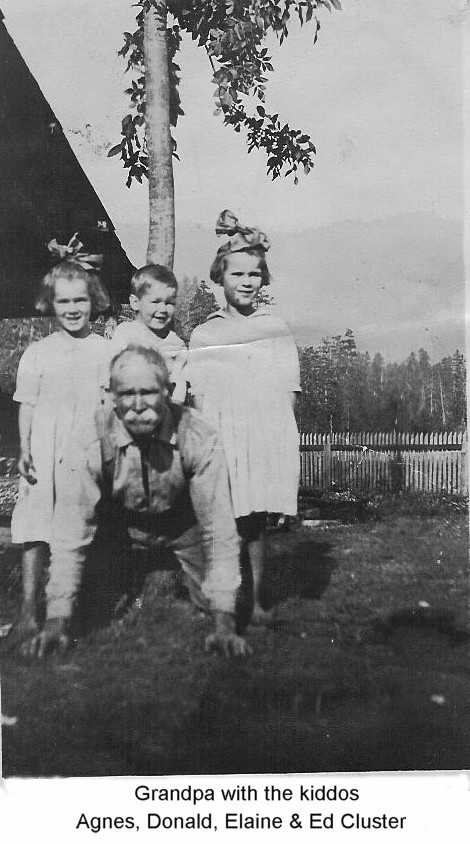
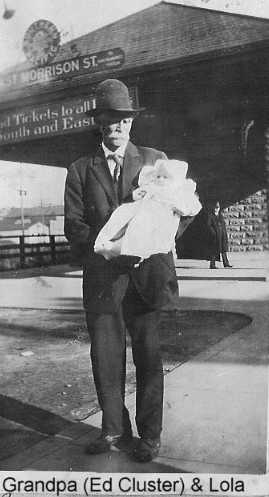
In 1930 we find Eddy K. Cluster, age 76, living alone in a home he owned, not in a prison cell, so at least we know, for whatever it was that they actually did or tried to do, Frank and Eddy didn't get the electric chair. Eddy was a retired house carpenter and prospector, a widower who had raised his six children on his own after 13 years of marriage. His wife had died when she was about 32 years old, and Eddy (see photos) had never remarried. Eddy was born in Missouri and worked as a farmer and rancher in Nebraska before moving his family to a new farm in Oregon.
Personality
inventor, promoter, family man
Legal Problems?
Twice accused of selling stock without permission from government agencies.
Articles & Graphics
More information on the inventor and the invention, if available:
- Kenney Air Driven Auto photo outside (source and year unknown)
- Air Driven Auto by Frank E. Kenney displayed in a storefront (year and source unknown)
- Eddy Cluster with some grandchildren.
- Eddy Cluster with a grandchild.
- Frank Kenney's Air Car Patent
- Frank Kenney's Injector Patent
- The Oregonian (Portland, Oregon), June 13, 1928, page 17: Kenney Air Driven Auto part 1a
- Oregon Daily Journal (Portland, Oregon), June 13, 1928, page 5: Kenney Air Driven Auto part 1b
- Oregon Daily Journal (Portland, Oregon), June 19, 1928, page 8: Kenney Air Driven Auto part 2
- Oregon Statesman (Salem, Oregon), July 5, 1928, page 4: Kenney Air Drive Auto part 3
- Oregon Daily Journal (Portland, Oregon), July 18, 1928, page 3: Kenney Air Driven Auto part 4
- Oregon Daily Journal (Portland, Oregon), September 8, 1928, page 5: Kenney Air Driven Auto part 5
- F. E. Kenney death
- The Oregonian (Portland, Oregon), April 9, 1917, page 3: Kenney's torpedo invention
- The Oregonian (Portland, Oregon), September 9, 1920, page 9: Kenney's 1920 securities violation